
Brown University Digital Publications: OIPA’s newest member celebrates 10 years of digital scholarly publishing
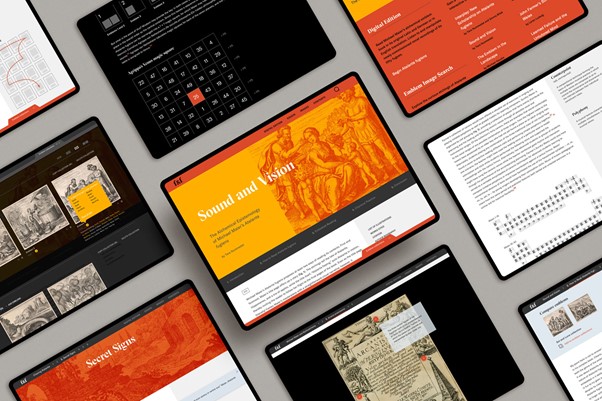
Brown University Digital Publications — generously launched with support from the Mellon Foundation in 2015 with additional support from the National Endowment for the Humanities and the Institute of Museum and Library Services — creates exciting new conditions for the production and sharing of knowledge by advancing scholarly arguments in ways not achievable in a conventional print format, whether through multimedia enhancements or interactive engagement with research materials. Brown partners with leading scholarly presses to bring peer reviewed, open access, multimodal content to global audiences. Widely recognized as accessible, intentional, and inclusive, Brown’s novel, library-based approach to born-digital monograph publishing is helping to set the standards for the future of scholarship in the digital age.
Director Allison Levy joins us to reflect on the journey so far.
Celebration & reflection
Congratulations on 10 years! Looking back, what are some of the key accomplishments you’re most proud of?
Thank you – it’s been a remarkable decade! What started in 2015 as a grant-funded experiment to support Brown University humanities faculty is now an established program that continues to grow in scope and impact. So far we’ve developed three multimodal monographs for publication with leading university presses, and all three publications have been recognized with major national or international awards. We recently partnered with the MIT Press to establish a book series devoted to visual literacy. Another point of pride is our commitment to opening up this innovative practice to authors from less well-resourced institutions, which we have been able to do in part through federally-funded training programs for authors, librarians, and students. In this area, we work very closely with the HBCU (historically Black colleges and universities) community.
What inspired the founding of Brown University Digital Publications, and has the mission and vision evolved over time?
The program originated from conversations with the Mellon Foundation in 2014 about the challenges of advancing the practice and recognition of long-form born-digital scholarly works. While a large part of Mellon’s investment in this area went to building out the digital infrastructure available to university presses, the Foundation also sought to support the community of scholars seeking to legitimate the expanded possibilities that digital publication offered for developing and presenting their research. To this end, a smaller number of grants through the Foundation’s Digital Monograph Initiative was awarded to institutions experimenting with university-based models of support for faculty, ranging from developmental editing and design support to assistance in placing the work with suitable publishers.
At Brown, an initial grant of $1.3 million launched an experimental collaboration between the Dean of the Faculty and the University Library to encourage and support Brown faculty to showcase their research and scholarship on digital platforms, in dynamic new ways. By 2019, an external review of digital scholarship at Brown identified the initiative as a signature program for the University. That same year, Brown received a $775,000 renewal grant from Mellon. The program’s growth since then has continued to accelerate. In 2022, recognizing that the program had outgrown its “initiative” phase, Brown University Digital Publications was established. While we remain true to our original mission, to re-think scholarly publishing models, we believe that innovation and the inclusion of diverse voices and perspectives go hand in hand.
Are there particular projects or publications that best represent your vision and innovation?
I’ll highlight our very first publication, which established our signature approach: the integration of strong design and shape-shifting form to enact arguments and engage new audiences. Our goal is always to make technological and design choices that will ensure long-term access to complex scholarly works.
Furnace and Fugue: A Digital Edition of Michael Maier’s Atalanta fugiens (1618) with Scholarly Commentary brings to life in digital form an enigmatic seventeenth-century text, Michael Maier’s alchemical emblem book Atalanta fugiens. This intriguing and complex text reinterprets Ovid’s legend of Atalanta as an alchemical allegory in a series of fifty emblems, each of which contains text, image, and a musical score for three voices. Re-rendering Maier’s multimedia masterpiece as an enhanced and interactive digital scholarly work, Furnace and Fugue allows readers to hear, see, manipulate, and investigate Atalanta fugiens in ways that were perhaps imagined when it was composed but were simply impossible to realize in full before now. Whether through interactive visualizations of modern notation or a multifunctional space that allows users to curate, save, and share their own selection and arrangement of Maier’s emblems, Furnace and Fugue makes possible the capabilities implied by this early modern book with digital tools and features that also clarify and/or advance the arguments of the eight interdisciplinary essays included in the work.
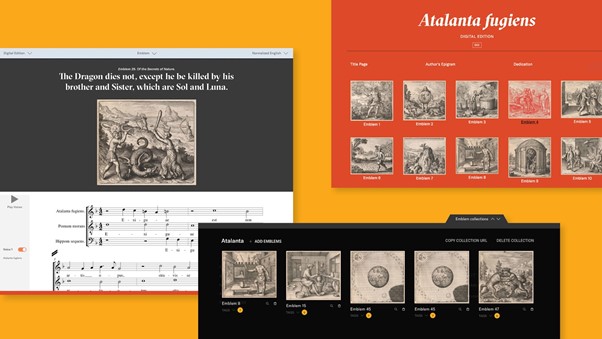
Furnace and Fugue, which received the 2022 Roy Rosenzweig Prize in Creativity in Digital History by the American Historical Association, was co-edited by Brown University Professor of History Tara Nummedal and Independent Scholar Donna Bilak. Published by the University of Virginia Press in the well-established series Studies in Early Modern German History in 2020, a print run would have yielded no more than 500 copies. Since its publication in July 2020, Furnace and Fugue has galvanized a global audience, attracting more than 30,000 unique users from 170 countries. Moreover, it has reached non-specialist audiences we never anticipated, including present-day alchemists. All of our titles have enjoyed remarkable global reach to thousands of readers across hundreds of countries in a short amount of time.
What is the impact of your training institute for scholars?
Recognizing that the majority of this innovative work is being generated at well-resourced, predominantly white institutions, BUDP strives to make the digital publication process more accessible and inclusive through purposeful training and mentoring programs.
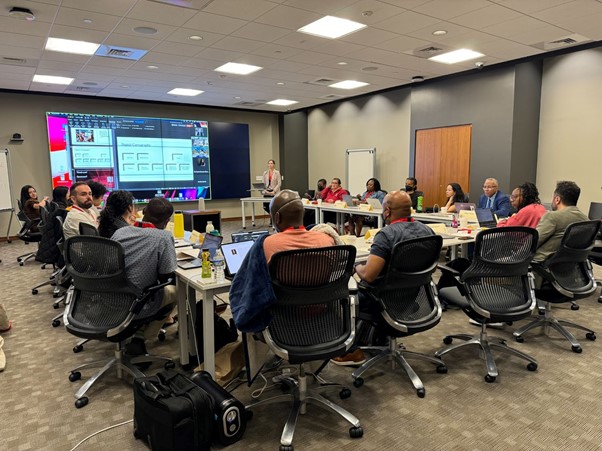
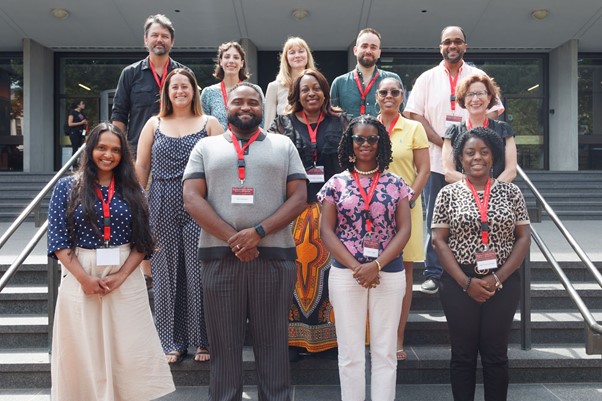
Born-Digital Scholarly Publishing: Resources and Roadmaps, a National Endowment for the Humanities Institute on Advanced Topics in the Digital Humanities, supports up to 15 scholars who wish to pursue interpretive projects that require digital expression, but may lack the necessary resources and capacity at their home institutions. First offered in 2022 and again in 2024 (for both cohorts, more than half of the participants came from Minority Serving Institutions), the three-week hybrid summer institute offers in-depth knowledge of the digital publishing process, familiarity with open source tools and platforms, advanced project management skills, concrete and individualized plans for project advancement, and top-level publishing industry contacts. The full curriculum is made publicly available on the Institute website.
In 2024, Brown University Library received a three-year Implementation Grant from the Institute of Museum and Library Services Laura Bush 21st Century Librarian Program to establish a cross-organizational training and support program for HBCU library professionals seeking to gain or expand expertise in developing open access born-digital scholarship. The University of Michigan Press is collaborating with BUDP to mentor the cohort and, via an open access publishing model, disseminate HBCU-generated peer-reviewed digital publications to the broadest possible audience for the greatest possible impact. This expansive cross-organizational approach to training is building capacity at HBCU libraries while providing extended author support over the full lifecycle of the digital publication process.
Both the NEH- and IMLS-funded interventions developed by Brown address equity issues that persist in the scholarly publishing ecosystem by establishing models for enhanced support for less-well-resourced staff, faculty, and students in order to enrich and expand scholarly discourse through their contributions.
Regarding outcomes, there is no stronger voice than that of the cohort, who continue to tell us about the ongoing value and impact of the Institute on their scholarship and communities:
- “The NEH Institute was transformative! I learned so many great concepts that I am now introducing to my students at Howard University and implementing within my work as a public historian. Digital publishing is something that I had not been very familiar with, and now I am working on a born-digital project that was initiated due to this Institute. The program’s dedication to diversity and inclusion was very apparent, and it was refreshing to meet scholars from the various universities and from different backgrounds.”
- “The Institute served as the catalyst I needed to kickstart my research agenda … Alongside new friends and colleagues from across the country, I shaped my digital manuscript chapter by chapter… I am so pleased that this Institute bolsters the credibility for digital publishing as a scholarly form.”
Press directors and acquisitions editors, who make up 60% of the Institute faculty, have gained a greater understanding of the rapidly growing author interest in pursuing multimodal publications as well as the specialized editorial support required to bring these projects to publication. Moreover, these grants enabled Brown to continue expanding the reach of its pioneering approach to born-digital scholarly publication beyond the campus, while also underscoring the University’s larger commitment to equity and diversity. It has further elevated the distinction and reputation of digital scholarship at Brown, and created an “extended family” of digital scholars for which Brown is a hub.
Exploring the model
Who makes up your core team?
BUDP has 4 full-time staff members:
- Allison Levy, Director
- Cosette Bruhns Alonso, Assistant Editor
- Crystal Brusch, Digital Publications Designer
- Holiday Shapiro, Digital Content Specialist
Another arm of BUDP extends to training Brown undergraduate and graduate students as well as postdoctoral fellows in the rapidly evolving field of dynamic born-digital publishing. Over the last decade we’ve worked with dozens of students, and we’ve hosted two Diversity in Digital Publishing Postdoctoral Research Fellows (our Assistant Editor got her start in digital publishing as our inaugural postdoc!).
What does “born-digital” make possible in comparison to traditional formats?
In short, in addition to introducing new ways of presenting scholarly ideas (from non-linear navigation to increased reader agency), Brown’s approach to born-digital publishing offers exciting new possibilities for collaboration, training, dissemination, and impact. We continue to think and operate in the realm of experimentation, and we see it as our responsibility to create new models for multiple communities.
How are the digital publications funded? Are there any costs to the authors or their departments?
Project costs vary depending on the complexity of the project. The maximum cost for bespoke website design and development with external expertise does not exceed $50,000/project. The decision to work with vendors is based on a combination of author readiness and staff capacity. Many complex projects are developed fully in-house with minimal cost. Some press partners request underwriting costs to help cover unfamiliar challenges and expenses related to this new publication format. Underwriting support does not exceed $10,000/project. These costs are funded by the Library; there are no costs to the authors or their departments. A one-time course reduction is made possible through the Office of the Dean of the Faculty. I should add that at Brown, peer-reviewed multimodal monographs are accorded the same weight as print monographs in the review process for tenure and promotion, and we are especially attentive to the needs of our early career scholars, one of whom was promoted to associate professor last year with a tenure dossier that included a digital publication.
How do you decide what to publish?
BUDP has a formal intake process. An annual call for proposals is circulated every September. Interested faculty members are invited to meet with the editorial team to discuss publication projects that demonstrate and include:
- scholarly excellence and potential for disciplinary impact;
- long-form narrative and sustained argumentation; and
- advancement of scholarly ideas through innovative digital presentation and engagement.
On average, we receive six proposals that are then reviewed by an editorial board composed of Brown faculty and administrators with digital publishing familiarity. It is not uncommon to receive queries from new faculty hires before their arrival on campus. On average, we accept two projects per year. There is growing interest beyond the core humanities program, notably in the field of public health.
What does the production process look like for a publication?
Scholars receive robust editorial and technological support from start to finish. For every publication, BUDP manages editorial, design, and digital production (we are platform agnostic, letting the content and the desired user experience guide this decision). We look to our press partners to manage peer review, copy editing, and marketing. In the majority of cases, Brown hosts the work on a University server and is responsible for maintenance and preservation. Brown may or may not hold the copyright to the work; in the majority of cases, we do.
That’s the general division of labor, although almost every aspect of this workflow is collaborative. For example, once we match a project to a press, we work with the acquisitions editor to move the project through peer review. Either a “digital partial” (which we define as a staging site reflecting overall design, organization, and navigation with one to two sample chapters ingested) or the full draft site (that is, the staging site with all content ingested, possibly with some placeholder content) will undergo rigorous review based on current guidelines for evaluating digital scholarship. Marketing and discoverability is a joint effort.
What have been your biggest challenges over the last 10 years?
Keeping up with demand! There is no shortage of interest among authors. On our own campus, we have to turn away projects. And I regularly receive queries from scholars around the world looking for project development support. Unfortunately, we do not have the capacity to accept all the excellent proposals we receive. Similarly, academic publishers are responding enthusiastically to the program’s projects and approach, and the network of presses ready to take this particular digital leap is rapidly expanding. Every press we’ve partnered with to date wants to do a second project with Brown!
Openness, equity and community
You recently joined the Open Institutional Publishing Association (OIPA)—what drew you to this community?
We are thrilled to be a part of this like-minded, forward-looking community. The commitment to open access publishing combined with substantive author support efforts comes with real challenges. However, pressing ahead to achieve these goals is critical. Membership in OIAP provides access to ideas as well as opportunities to share all that we’ve learned along the way. It takes a dedicated and generous community to figure out collectively best practices and priorities in this rapidly evolving landscape. That we are not a press but rather more of a producer is a testament to Brown’s unique contributions to the scholarly publishing ecosystem. We’re honored to be on this journey with our OIPA colleagues.
Many OIPA members are based in the UK. Do you think that being based in the USA gives you a different perspective?
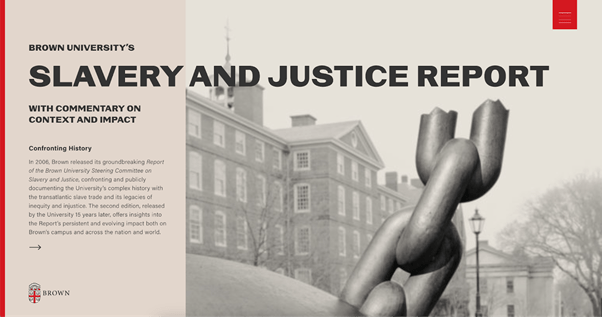
Slightly, yes, considering nuances related to open access and accessibility requirements. But we do see ourselves as a global practitioner. Many of our works are bilingual, and they certainly have global reach. Let me cite another set of user statistics: Brown University’s Slavery and Justice Report with Commentary on Context and Impact, published in November 2021, has had 31.8k unique users and 68k page views by readers from 181 countries. And to shift for a minute from programmatic to personal reflection, I am frequently in the U.K. for conferences and feel very much at home there. In fact, in my earlier career as an art historian, I taught at UCL. So from the scholarly perspective, there is a familiarity that serves me well in the current work.
How do you ensure publications are discoverable to a global audience?
Aside from the open access publishing model, we work with librarians here at Brown and at our press partner institutions to maximize cataloguing efforts. Similarly, we work extensively with the marketing teams at the presses on both print and digital promotional materials. We’ve also partnered with Project Muse to provide an additional pathway to discovery.
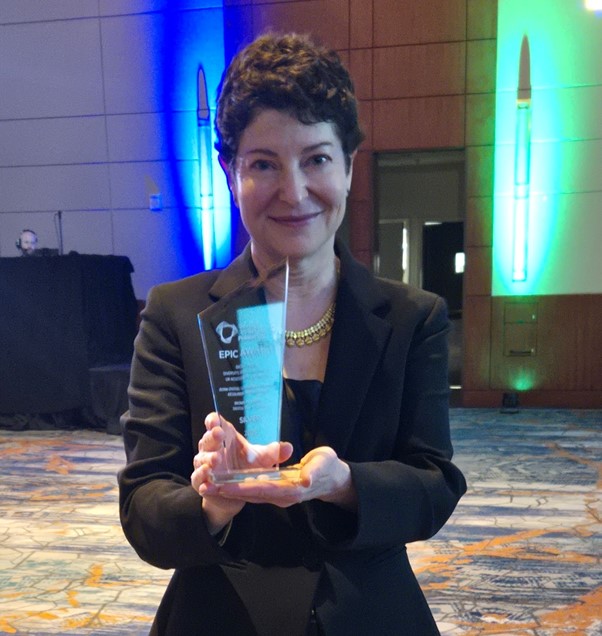
Brown University Digital Publications won a silver award in the 2025 Excellence in Publishing, Information Technology & Communications (EPIC) Awards. What does that recognition mean to you?
It’s a tremendous honor to have been recognized by the Society for Scholarly Publishing for our promotion of inclusive practices, equitable access, and meaningful representation within scholarly publishing. This significant industry award highlights “Born-Digital Scholarly Publishing: Resources and Roadmaps,” the NEH Institute developed by BUDP and offered in 2022 and 2024 (described above). Both institutes achieved a majority participation of scholars from historically Black colleges and universities, Hispanic-serving institutions, Asian American and Native American Pacific Islander-serving institutions, and community colleges as well as emeriti faculty and independent scholars. This crucial re-prioritization of how and for whom the practice and production of digital scholarship is taught will have a profound impact on current and future generations of scholars. We hope this recent recognition will encourage others in the industry to push boundaries and achieve new heights.
Looking forward
What’s next for Brown University Digital Publications? Are there new directions or technologies you’re excited to explore?
We will continue to be inspired and energized by diverse voices and viewpoints, and we will continue to think big and innovate boldly, and we will continue to establish new partnerships with authors, presses, and museums, all while maintaining a commitment to accessible, intentional, and inclusive practice.
We’re especially excited about our newest partnership, this one in support of Indigenous voices: “Navigating Best Approaches and Practices for a Digital Publishing Program in Micronesia” is a Mellon-funded collaboration with the University of Guam Press. In addition to co-producing a pilot publication documenting contemporary knowing of Micronesian traditional navigation, the partner institutions will document overarching protocols for the receiving and sharing of Indigenous and traditional knowledge on a born-digital platform. This work will be guided by elders and traditional and community leaders.
What would you say to other institutions or libraries considering launching similar initiatives?
The work is exhilarating, every day. Go into it willing to think outside of the box, ready to reconsider conventional workflows, and prepared to figure it out as you go – and as a team. You will learn a tremendous amount, and you will re-think scholarly publishing in fresh and provocative ways. The reward is in the reach. First, you’ll see how possibilities for new presentations of scholarly ideas resonate profoundly with authors. Next, you’ll see that readers from all over the world – specialists and non-specialists alike – are actively engaging with these ideas and sharing them with their students and broader communities. I would also say, call me anytime!
If you could reimagine academic publishing from the ground up, how would it look?
In one word, collaborative.
 Open Institutional Publishing Association
Leave a comment